
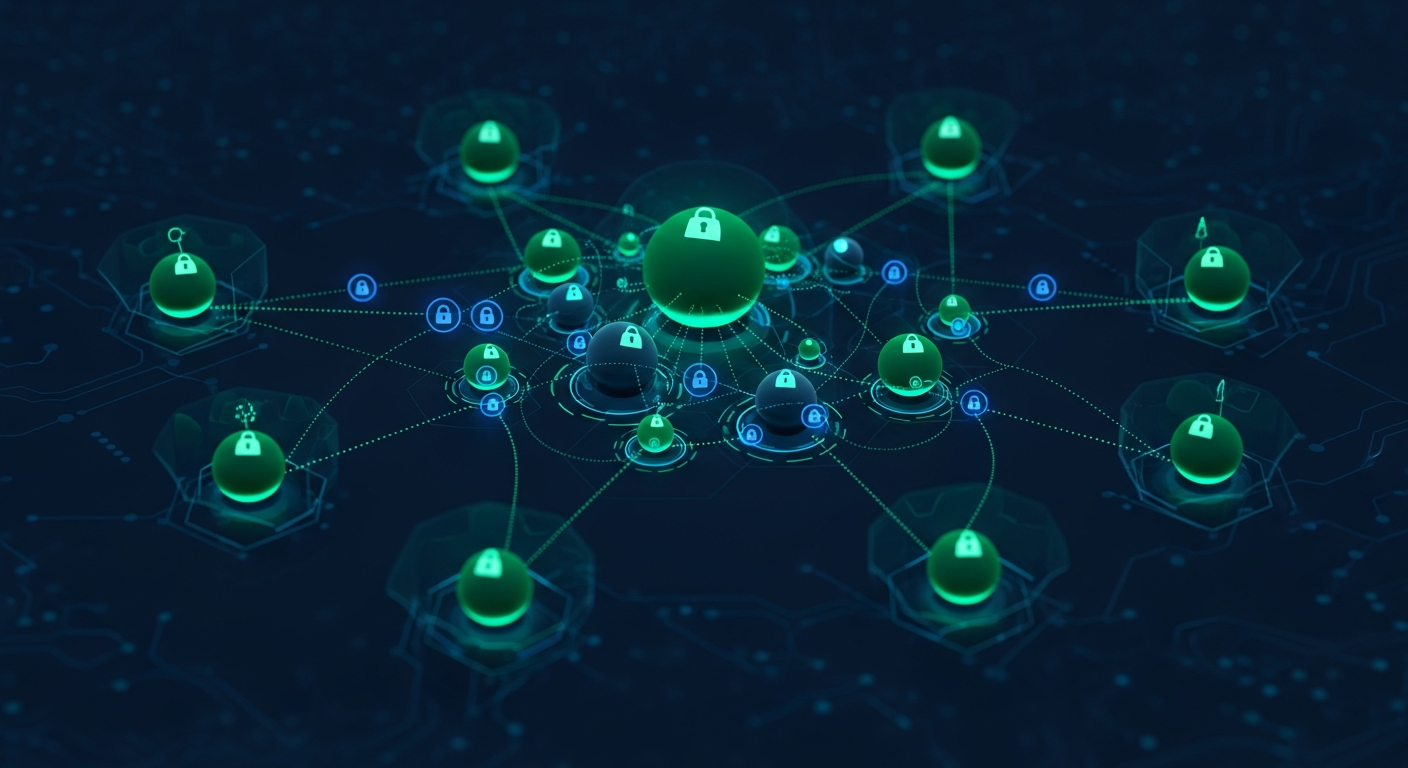
Introduction: The Rise of Multi-Agent Systems and Their Unique Security Challenges
The trajectory of agentic AI has shifted decisively from single-agent architectures toward multi-agent systems (MAS), where specialised agents collaborate, delegate, and negotiate to accomplish complex objectives. From autonomous supply-chain orchestration to distributed code-generation pipelines, organisations are deploying fleets of agents that communicate over shared channels, invoke each other's capabilities, and make decisions with real-world consequences.
This architectural shift introduces a category of security challenges that traditional application security frameworks were never designed to address. When agents trust other agents, when an orchestrator delegates tasks across a chain of subordinates, and when messages flow between components that each have their own context windows and decision-making logic, the attack surface expands in ways that are both novel and deeply consequential.
The security of a multi-agent system is not the sum of the security of its individual agents. It is determined by the weakest trust boundary between them.
In this article, we examine the core security patterns that practitioners must adopt to harden multi-agent deployments. We address inter-agent trust, orchestration integrity, privilege delegation, message validation, coordination attack surfaces, and secure communication—providing actionable guidance grounded in real-world threat modelling.
1. Inter-Agent Trust Models
In a multi-agent system, the fundamental question is: why should one agent trust another? The answer must never be "because it is part of the same system." Identity and trust must be explicit, verifiable, and continuously evaluated.
Zero-Trust Between Agents
Zero-trust architecture, now standard in enterprise networking, must be extended to agent-to-agent interactions. Every request from one agent to another should be authenticated, authorised, and validated—regardless of whether both agents run within the same orchestration framework or share the same infrastructure. An agent compromised through prompt injection, tool misuse, or data poisoning becomes an insider threat with potentially broad lateral movement capabilities.
In practice, this means each agent must maintain a cryptographic identity (such as a signed certificate or a verifiable credential), and every inter-agent call must present proof of that identity alongside a scoped authorisation token.
Capability Tokens
Rather than granting agents broad role-based access, capability tokens encode precisely what an agent is permitted to do in a given interaction. A capability token might specify: the target agent, the permitted action, the data scope, and an expiry timestamp. This is analogous to OAuth scopes but applied at the agent-to-agent layer, where the "resource" being protected is another agent's functionality.
Capability tokens should be minted by the orchestrator or a dedicated trust broker, and they should be unforgeable, time-bounded, and single-use where possible.
Trust Hierarchies
Not all agents are equal. A well-designed MAS establishes explicit trust hierarchies: the orchestrator operates at the highest trust level, specialist agents operate at lower levels, and ephemeral or third-party agents operate at the lowest. Trust flows downward through delegation, and each level in the hierarchy can only grant capabilities that are a strict subset of its own. Violating this principle—allowing a child agent to escalate permissions beyond what its parent holds—is the multi-agent equivalent of a privilege escalation vulnerability.
2. Orchestration Hardening
The orchestrator is the nervous system of a multi-agent deployment. It routes tasks, manages agent lifecycles, aggregates results, and enforces policy. Compromising the orchestrator means compromising the entire system.
Secure Orchestrator Patterns
A hardened orchestrator should operate as a reference monitor: every inter-agent interaction passes through it, and it enforces access control decisions on every transition. The orchestrator should not blindly forward messages between agents. Instead, it should validate that each message conforms to the expected schema, that the sending agent is authorised to make the request, and that the receiving agent is the correct destination for the task type.
Orchestrators should be stateless where possible, with state persisted to an external, tamper-evident store. This prevents an attacker from manipulating in-memory orchestration state to redirect agent workflows.
Message Routing Integrity
Agents should not be able to choose their own routing. If Agent A can arbitrarily address messages to Agent C (bypassing the orchestrator or intended workflow), then the system's security model is bypassed. Routing tables should be immutable during a workflow execution, and any dynamic routing decisions should be made exclusively by the orchestrator based on pre-defined policies.
Preventing Privilege Escalation Through Delegation Chains
Delegation chains—where Agent A delegates to Agent B, which delegates to Agent C—are a critical attack vector. Each link in the chain must enforce capability narrowing: the delegated task must carry strictly fewer permissions than the delegating agent holds. Without this constraint, an attacker who compromises a low-privilege agent can craft a delegation request that tricks an upstream agent into performing a high-privilege action.
Every delegation is a potential privilege boundary. Treat it with the same rigour you would apply to a network firewall rule.
3. Least-Privilege Delegation
The principle of least privilege is well understood in traditional security, but its application in multi-agent systems requires careful adaptation.
Scoped Task Assignments
When an orchestrator assigns a task to an agent, the assignment should include an explicit capability envelope: the tools the agent may invoke, the data it may access, the external services it may contact, and the actions it may take. This envelope should be enforced at the runtime level, not merely declared in a system prompt that the agent could be manipulated into ignoring.
Capability Narrowing
As tasks flow through a delegation chain, capabilities must narrow monotonically. Agent A, holding permissions {read, write, execute}, may delegate a sub-task to Agent B with permissions {read, execute}, but never with permissions {read, write, execute, delete}. The enforcement mechanism must be external to the agents themselves—typically implemented by the orchestrator or a capability broker that validates every delegation request against the delegator's current permission set.
Temporal Permissions
Permissions should have explicit time-to-live (TTL) values. An agent authorised to access a database for the duration of a query should lose that access the moment the query completes. Temporal permissions prevent a compromised agent from maintaining persistent access to resources long after its legitimate task has concluded. Implementation patterns include short-lived JWTs, lease-based access tokens, and session-scoped credentials that are revoked on task completion.
4. Message Validation and Integrity
Inter-agent messages are the bloodstream of a multi-agent system. If an attacker can inject, modify, or replay messages, they can subvert the entire workflow.
Schema Enforcement
Every inter-agent message should conform to a strict, versioned schema. The orchestrator and each receiving agent should validate inbound messages against this schema before processing. Schema enforcement prevents injection attacks where a malicious agent embeds unexpected fields—such as overridden instructions or additional tool calls—in a message payload.
Schema validation should occur at the transport layer, before message content reaches the agent's language model. This is critical because LLM-based agents are susceptible to treating unexpected message fields as instructions.
Content Validation
Beyond structural schema checks, the content of messages should be validated for semantic correctness. If Agent B returns a "database query result" to Agent A, the orchestrator should verify that Agent B was actually assigned a database query task, that the result format matches expectations, and that the data volume is within expected bounds. Anomalous content—such as an unexpectedly large payload or a result containing executable code—should trigger alerts and quarantine procedures.
Replay Protection
Each message should carry a unique nonce and a timestamp. The receiving agent (or the orchestrator) should reject messages with duplicate nonces or timestamps outside an acceptable window. Without replay protection, an attacker who captures a legitimate inter-agent message can re-send it to trigger duplicate actions—such as repeated financial transactions or redundant resource provisioning.
5. Coordination Attack Surfaces
Multi-agent systems introduce attack surfaces that do not exist in single-agent or traditional software architectures. Understanding these is essential for effective threat modelling.
Confused Deputy Attacks
In a confused deputy attack, a malicious or compromised agent tricks a higher-privilege agent into performing an action on its behalf. For example, Agent B (low privilege) sends a carefully crafted message to Agent A (high privilege) that causes Agent A to invoke a sensitive tool, believing the request is legitimate. The defence is strict capability verification: Agent A must verify not only its own permissions but also whether the requesting agent is authorised to trigger the action in question.
Collusion Attacks
When multiple agents are compromised—or when a single attacker controls multiple agents—they can collude to bypass security controls that would stop any individual agent. For instance, two agents might coordinate to assemble a prohibited action from individually permitted sub-actions. Detecting collusion requires cross-agent behavioural analysis: monitoring patterns of inter-agent communication for anomalous coordination, and enforcing separation-of-duty policies that prevent any combination of agents from assembling prohibited capabilities.
Information Leakage Between Agents
Agents that share an orchestration context may inadvertently leak sensitive information to each other. If Agent A processes confidential financial data and its output is passed (even in summarised form) to Agent B, which has no authorisation to access financial data, the system has created an information flow violation. Data classification labels should travel with information through the agent pipeline, and the orchestrator must enforce that agents only receive data matching their clearance level.
Side-Channel Risks
Shared infrastructure creates side-channel risks. Agents running on the same compute node may leak information through timing, memory access patterns, or shared caches. Agents sharing a vector database may infer each other's queries through embedding similarity. These risks demand infrastructure-level isolation for agents handling data at different sensitivity levels, and careful partitioning of shared resources like embedding stores and tool registries.
The most dangerous attacks on multi-agent systems exploit the gaps between agents—the trust boundaries, the shared contexts, the implicit assumptions about peer behaviour. Hardening individual agents is necessary but insufficient.
6. Secure Communication Patterns
With trust models, validation, and attack surfaces addressed, the final layer is the communication infrastructure itself.
Signed Messages
Every inter-agent message should be cryptographically signed by the sending agent using its private key. The receiving agent (or orchestrator) verifies the signature against the sender's known public key before processing. This prevents message spoofing and provides non-repudiation: if an agent sends a malicious message, the signature constitutes proof of origin. Ed25519 or similar lightweight signature schemes are well-suited to the high-throughput, low-latency requirements of agent communication.
Encrypted Channels
Inter-agent communication should be encrypted in transit, even within internal networks. Mutual TLS (mTLS) is the recommended approach: both the sending and receiving agents present certificates, providing simultaneous authentication and encryption. For systems where agents communicate through message queues or event buses, message-level encryption (using envelope encryption with per-message symmetric keys) ensures confidentiality even if the transport infrastructure is compromised.
Audit-Logged Interactions
Every inter-agent message, delegation event, capability token issuance, and permission check should be written to an append-only, tamper-evident audit log. This log serves three functions: forensic investigation after incidents, real-time anomaly detection through log analysis, and compliance evidence for regulatory frameworks. The audit log should capture the full message metadata (sender, receiver, timestamp, nonce, capability token), a hash of the message content, and the outcome of any security checks performed.
In high-security deployments, consider implementing a Merkle tree or blockchain-adjacent structure for the audit log, ensuring that any tampering with historical records is cryptographically detectable.
Key Takeaways
Securing multi-agent systems demands a fundamentally different approach from securing individual AI agents or traditional distributed systems. The following principles should guide every MAS security architecture:
- Adopt zero-trust between agents. Authenticate and authorise every interaction. Never assume that a peer agent is trustworthy because it shares the same infrastructure or framework.
- Harden the orchestrator as a reference monitor. All inter-agent communication should flow through a secured orchestrator that validates, routes, and logs every message.
- Enforce monotonic capability narrowing. Permissions must decrease as delegation depth increases. No agent should be able to grant more capabilities than it holds.
- Use temporal permissions and single-use tokens. Access should expire automatically. Long-lived credentials in multi-agent systems are ticking time bombs.
- Validate messages at the transport layer. Schema enforcement, content validation, and replay protection must occur before message content reaches an agent's language model.
- Model coordination attack surfaces explicitly. Confused deputy, collusion, information leakage, and side-channel attacks are first-class threats in MAS. Include them in every threat model.
- Sign, encrypt, and log everything. Cryptographic message signing, mutual TLS, and tamper-evident audit logs form the baseline communication security for any production multi-agent deployment.
- Isolate agents by data sensitivity. Agents handling different classification levels of data should run on isolated infrastructure with partitioned shared resources.
Multi-agent systems represent the next frontier of AI capability—and the next frontier of AI risk. The patterns described in this article are not theoretical ideals; they are practical requirements for any organisation deploying agentic AI at scale. The time to implement them is before the first inter-agent message is sent.