
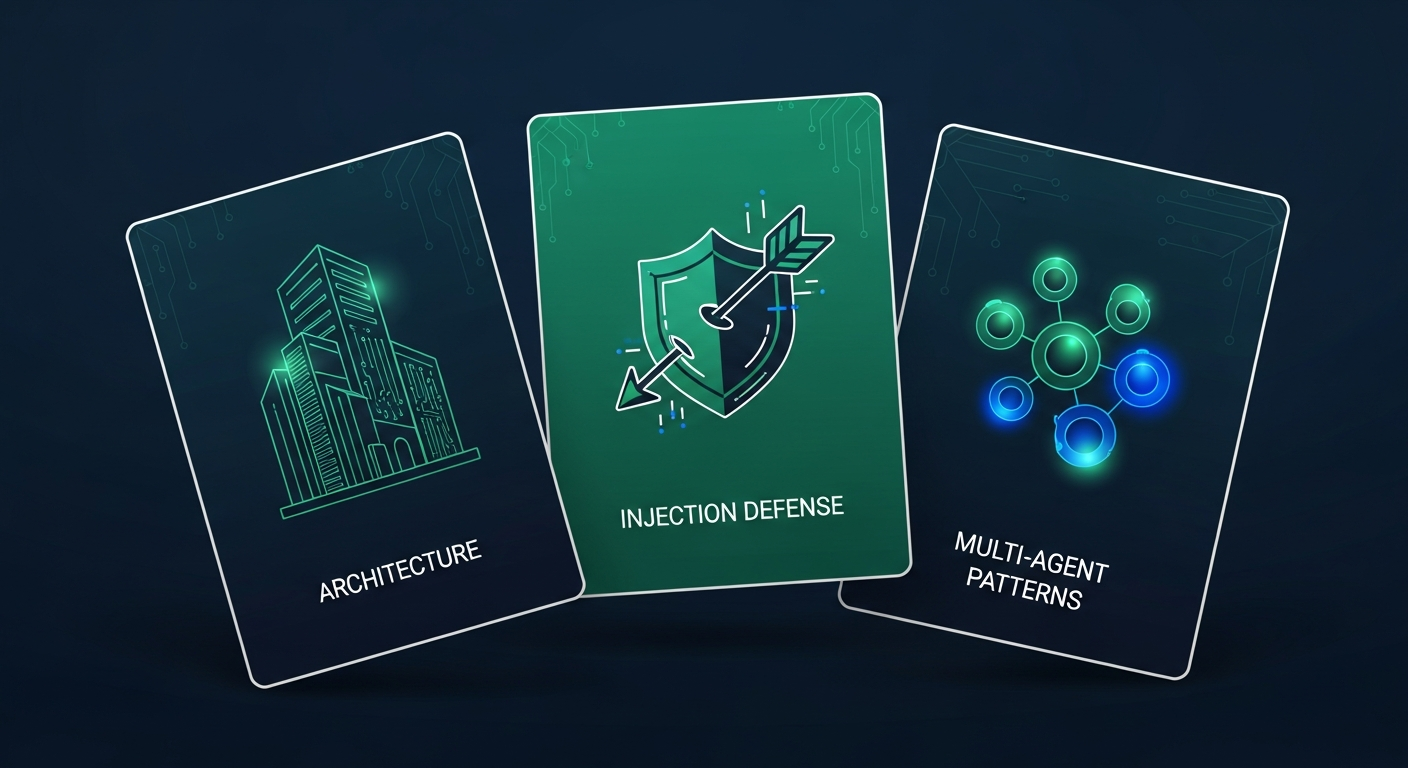
The first wave of SecuRight blog content is live. These three articles establish the editorial foundation for everything that follows — deep technical analysis of the security challenges unique to agentic AI, written for the practitioners who are building and defending these systems.
The posts
Agentic AI Security Architecture
This article lays out a reference architecture for securing autonomous AI agents in production environments. It covers the trust boundaries that emerge when agents gain tool access, memory persistence, and planning capabilities, and maps each boundary to concrete security controls. If you are deploying agents and need a structural framework for thinking about where risks concentrate, start here.
Prompt Injection Security
Prompt injection remains one of the most persistent and misunderstood threats in agentic AI. This post goes beyond surface-level descriptions to analyze the injection vectors that are specific to autonomous agents — including indirect injection through tool outputs, memory poisoning, and cross-agent contamination. It presents a layered defense model with input validation, output filtering, and runtime monitoring working in concert.
Multi-Agent Security Patterns
When multiple agents collaborate on a shared task, the security surface expands dramatically. This article examines the coordination patterns that introduce risk — shared memory stores, delegated tool access, and inter-agent message passing — and provides defensive patterns for each. It includes guidance on isolation boundaries, privilege scoping, and audit trail design for multi-agent workflows.
Editorial direction
These three posts are intentionally sequenced. The architecture piece provides the conceptual scaffolding. The injection article addresses the single most exploited attack surface. The multi-agent piece extends both topics into the increasingly common scenario of agent-to-agent collaboration.
Every article we publish follows the same editorial standard: technically rigorous, implementation-focused, and grounded in patterns we have observed in real deployments. We avoid hype-driven framing and speculative threat scenarios. If a risk has not been demonstrated in practice, we say so. If a mitigation has known limitations, we document them.
Our editorial roadmap for the coming months includes posts on agent authorization models, memory and context security, runtime monitoring strategies, and secure tool integration patterns. Each post will build on the foundation established in this first wave, creating a coherent body of knowledge rather than a disconnected collection of articles.
Read the posts
We welcome feedback from practitioners. If you have encountered patterns or edge cases not covered in these articles, reach out through the enquiry form.